Showing posts with label ore fabrica. Show all posts

Tuesday, 28 August 2012

The Emperor's new clothes?

The Antipodean Mariner has been a frequently commentator on Vale's failing strategy to control freight from Brazil to China. The fleet of 400,000 DWT ValeMax ore carriers remain unwelcome on China's maritime doorstep.

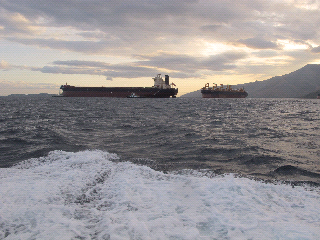
Seen this week at Subic Bay are not one, not two but three laden ValeMaxes ('Vale Qingdao', 'Berge Everest' and 'Vale Rio de Janiero') plus three Capesize bulkers and Ore Fabrica.

From 10th August, when the AM watched 'Vale Qingdao' rafting up with 'Berge Townsend' and 'Ore Fabrica', it has taken 18 days to discharge the full cargo at an average of about 22,000 tonnes per day. Claiming 5,000 tonnes per hour, achieving less than 1,00 tonnes per hour.

With maybe US$600 million in assets anchored, how long can Vale continue to 'spin' the good news story that Subic Bay represents a viable trans-shipment alternative to China's deep water ore ports?

AM

Day 0 - Rafting up after 13 days anchored
Day 15 - Rafted with 'Samjohn Vision'
Day 15 - Vale Rio de Janiero (left) and Berge Everest (right) anchored
awaiting their turn to discharge with another two Capes to seaward.

Monday, 6 August 2012

In Subic Bay

It's raining, raining so hard that a sailing jacket and overpants are almost useless. Water is pouring off the decks and the Yard has told us the the Government Maritime Safety Authority has to give permission for us to put to sea in the morning.

We have a full contingent from the Owners, Ship Managers, senior Officers and MAN-B&W, the engine makers. The Captain is an experienced hand and has commanded one of our Post-Panamax bulk carriers. The final pre-trials meeting with the Yard has satisfied us that PN66 is ready for sea. One night ashore and then to sea until Thursday.

At anchor in the Bay, looks like one of the STX ValeMaxs fully loaded, Ore Fabrica and a Bergesen Cape. No cargo being transferred today.

Will keep a daily log and post when we get into wi-fi. Photos of RTM Dampier PN67 behind us and RTM Zheng He ahead.

AM


Thursday, 28 June 2012

Three fat ladies

Columbus, the AM's new source in Subic Bay, has sent the photos below of BW Bulk's 388,00 DWT 'Berge Aconcagua' (red hull), 'Ore Fabrica' (black hull) and the 203,000 DWT 'China Steel Team' grey hull rafted together in the inner harbour.

Th tug 'Perseverance' is standing by the trio as they swing around Ore Fabrica's anchor.


Berge Aconcagua must have part discharged in Japan (Oita) and over-carried at least a Cape's worth for this trans-shipment.

AM

Wednesday, 27 June 2012

Vale's Chinese charm offensive


Ore giant Vale are currently running a 'charm offensive' - a book in English and Chinese on the technical excellence of the Valemax vessels, Letters to the Editor, media commentary...

Dance of the giants, Subic Bay AIS

Despite of (or maybe because of) China's stonewalling, the Subic Bay operation seems to be back in business. Today's screenshot from AIS shows 'Berge Aconcagua'  and 'China Steel Team' being manouevred around 'Ore Fabrica'. Not sure what 'Aconcagua is doing is Subic as she has just broken records for discharging in Oita, Japan. Maybe she has over-carried some cargo to test Fabrica's transfer system?

Today's Op-Ed from Lloyd's List

The lowdown on Valemaxes

Brazilian iron ore giant’s book makes the case for 400,000 dwt ships

Tom Leander

Wednesday 27 June 2012

VALEMAX vessels are banned from China — this everyone knows.
But the facts underlying the ban, a straightforward account of what happened, how it came to pass and its status now have been a matter of detective work and speculation in the press.
All parties involved — the government, stakeholders in China and the government departments with the final say on approving Vale’s big ships — have offered only limited information regarding their strategy and decisions.
Vale has now changed that with a remarkable document describing its valemax strategy, as much as you would ever want to know about the 400,000 dwt ships, why Vale invested in them and how it believes the ships will benefit the Chinese economy.
If this were Washington rather than Beijing, the brochure — really a small book running to 75 pages — would be regarded as a lobbying document.
Its aim is to persuade, but unlike some position pieces it is also a mine of information and deploys a fair and open style, making a best case while weighing up the arguments against its cause without rancour.
The booklet is published in English and Chinese and seems more aimed to readers in the transport, iron ore trading and steelmaking constituencies in China than at an English-language audience.
It also offers clarity for those trying to understand the point of view of the Chinese government, publishing translations of the various circulars by the Ministry of Transport concerning the valemax ships.
One of the interesting approaches of the booklet is to add nuance to English readers’ understanding of the Chinese scene. So often seen as a monolith in the west, China’s authorities have often very strong differences in point of view and must respond to the constituencies they govern.
The wording of the valemax ban — in the view of this newspaper, though not the view of the valemax book — was ambiguous enough to reflect a certain reluctance to impose an absolute ban.
Our interpretation is that this is because China’s Ministry of Transport represents more than the shipowners that took exception to the valemax ships, arguing against their safety and also that they would create a monopoly that would hurt the businesses of China’s shipowners.
In fact, the ministry represents diverse national interests and there are other constituencies in China — steel mill operators, port operators and iron ore traders — that see the ships not as a threat but as a potential boon.
The real business of the Ministry of Transport’s Circular 13 was to remove the “one-case-one” basis, in Vale’s translation, at local ports.
Ports were allowed to let valemax ships on a case-by-case assessment, with the ports later required to submit the reasoning behind the approval to the MoT.
Having had the case-by-case allowance withdrawn, ports must now wait for a blanket approval from the MoT — or a possible return to case-by-case status — before allowing the ships to enter.
The reason that the MoT offered was concern for safety. “Given that the safety of the operation of the super large vessels at ports is not optimistic …” the circular reads in part. But the “given” is never explained.
It is clear where Vale stands, but it is refreshing to see it spelled out so plainly. “Vale was surprised at the MoT Circular 13 because it ended its policy, which allowed ports to decide the safety of berthing larger vessel types,” Vale writes. “Vale was surprised that safety was the main concern of Circular 13 …”
“It surprises us too,” Vale goes on to say, “that the valemax ships designed in China, in consultation with Chinese iron ore ports, built and launched from three Chinese shipyards, Rongsheng, Bohai and STX Dalian, are now restricted”.
The Brazilian iron ore giant makes its case that the ships have safety advantages over conventional bulkers. They require “60% fewer port manoeuvrings for the same amount of ore delivered”.
This cuts back on port congestion and reduces the risk of an accident. The hold design, Vale says, minimises the movement of iron ore, which makes the ships more stable. Fully loaded, valemaxes have a draft of 23 m, which Vale says is similar to other dry bulk ships berthing in China.
Vale also notes that “if required, by some ports, lightering in transhipment stations can reduce the draft of valemaxes”.
The Brazilian company then says: “China’s main ports are world leaders in design and are regularly receiving container and oil tanker ships larger than valemax ships.”
It goes on to say that: “Chinese ports were consulted during the design of the valemax ships, signed co-operation memoranda of understanding as early as 2009 and are among the first in the world well prepared for valemax ships. Soon ports in other countries such as Korea and Japan will catch up, [as] the European ports already did.”
Vale takes a dim view of the consequences of persisting with the ban at a time when China’s economy has slowed to its lowest rate of growth in many years. The ban, it concludes, will hurt China’s ports and could compromise China’s steel industry.

AM

Sunday, 10 June 2012

Ore Fabrica

When the Antipodean Mariner returned to Subic yesterday, a familiar sight was missing from the lineup of ships in the bay.

Vale's Ore Fabrica has moved from anchor to alongside Keppel's ship repair facility. The Pilot advised that she has gone into the Yard for 'modifications'. The cranes on 'Fabrica are controlled by a single computer system which according to sources mean all the cranes stop if an individual crane has a fault.

So far, 7 weeks since Ore Fabrica moved a tonne of ore...

Antipodean Mariner

Monday, 28 May 2012

Ore Fabrica's baby conveyors?

Help is requested from the Blog's readership about a barge that's anchored in Subic Bay.

Vale's conveyor barge
This photo was snapped out of the car window - a conveyor barges (or barges?) anchored at the head of Subic Bay. The Agent reported that the barge is owned by Vale and is 'inserted' between Ore Fabrica and the off-take vessel during transfer operations. Looking at the outreach of the Ore Fabrica's cranes it is conceivable that they could be plumbed over the centre of 'Fabrica's ore holds and used (with the long-travelling ship loader) to grab cargo into the barge's hoppers and then up to the waiting Cape. The AM thinks he saw this barge in Subic Port in February, before Ore Fabrica started operations.

Can anyone fill in the gaps?

AM

Monday, 14 May 2012

Sea Trials Diary - Monday 14th May

After a very fast trip up to Subic Bay by by car this morning, the sea trials team arrived at the Yard at 10:30 and had a chance to see the 'babies' lined up on the quay.
RTM Cartier (left) and RTM Cook (right) on the Fitting Out Quay


'RTM Cook' underwent her Inclining Experiment today and was off limits to all but the Senior Officers and one Supervisor for the day. We were left to our own devices to explore the vessel under construction in Dock 6 - PN68/RTM Zheng He and PN67/RTM Dampier. We were lucky to witness the engine for RTM Zheng He being installed though missed the moment of lowering into place using the 600T gantry crane.


Yard workers unshackle the lifting rig from the Main Engine
One of the hanging conrods awaiting connection to the crankshaft
PN66/RTM Cartier is at about the same state of fit-out of as RTM Cook was at the last blog posting.


A mystery ship here is 'Ocean Corona', a 180,000 DWT Capesize lying at anchor with a very visible tide mark on her hull. She arrived in Subic fully laden on 14th April after loading Saldanha Bay, South Africa. It looks like she has flooded one of the forward ballast tanks - grounding or hull failure? She is back at near even keel but her hull betrays that she has been 'down by the head' for some time.


Ocean Corona at anchor


Well down by the head?
'Ore Fabrica' lies at anchor as well, riding high in the water. No ValeMax on the horizon or due in Subic Bay according to Lloyds Maritime Intelligence.


Ore Fabrica seen from RTM Cartier
The Antipodean Mariner

Saturday, 10 March 2012

Ore Fabrica and Ore Itagaui

Magellan, AM's eyes in Subic Bay, sent a quick note and photo last night of the operation in the inner harbour;

As of the evening of 9 March, the Ore Fabrica has discharged half her cargo into the Vale daughter vessel Ore Itaquai. Tugs have been kept standby all through - more as a safety precaution, since Ore Fabrica is currently anchored inside Subic Bay's inner anchorage - just off the Kalaklan light house. The early operation with Vale Brasil and Ore Pantanal was done in outer anchorage (south of Grande island)

The daughter vessel (Ore Itagaui) is towards us in the picture, and the Ore Fabrica is away from us. The daughter vessel will always be on the port side of the Fabrica, as that is where the shiploader is.


Tracking the 'comings and goings' at Subic Bay using Lloyd's List Intelligence, Vale are 18 days into the first (Vale Brasil) trans-shipment operation. The second vessel, Vale China, has been at anchor since 25th February (15 days now). While Ore Fabrica is a technological 'tour de force', the AM believes that the Beijing mandarins will be well satisfied at their handiwork.

As an aside, China's media are this week reporting that the Port of Dalian has opened it's new 400,000 DWT ore terminal. Somewhat ironic that China has been the beneficiary of the real financial investment in the construction of the ChinaMax ships, the conversion of the trans-loader Ore Fabrica and the construction of a 400,000 DWT ore port.

How many times can the ticket get clipped?


Antipodean Mariner

Monday, 5 March 2012

Analyst's report on Subic Trans-shipment

Commodore Research, a US brokerage, issued their Dry Bulk weekly report today which contained analysis of Vale's Malaysian and Subic transhipment hub strategy. Read with the AM's posting (Subic Sitrep, Feb 29th), maybe someone at Commodore follows this blog?

Iron Ore Transshipment Finally Completed - Commodore Research (5/3/12)

Vale’s Philippines floating iron ore transshipment hub, also known as the Ore Fabrica, has successfully completed its first iron ore transshipment. The first smaller Capesize vessel to leave the Ore Fabrica laden with iron ore is the 179,000 dwt Ore Pantanal.

The Ore Pantanal was loaded with iron ore from the Vale Brasil (the first VLOC to arrive at the Ore Fabrica) last week. The Ore Pantanal then set sail to deliver its cargo to buyers in Taiwan. A second VLOC, the Vale China, has also arrived but has not berthed alongside the Ore Fabrica as the Vale Basil has not left yet.

Another capesize vessel, the 300,000 dwt Ore Itaguai, is also still waiting to be loaded with iron ore. In addition, the 207,000 dwt Ocean Creation, which is sailing from Japan, is expected to arrive this week.

Overall, the use of this transshipment hub continues to be beneficial for the capsize market as it helps employ extra capesize vessels. In addition, transshipment is taking much longer than planned. The Ore Fabrica was previously announced as being capable of loading 5,000 tons of iron ore per hour, which would result in 180,000 tons of iron ore from a laden VLOC being loaded into a capesize vessel in about 36 hours.

12 days passed, however, before the Ore Pantanal was loaded with iron ore from the Vale Brasil and able to set sail to deliver the iron ore cargo to buyers in Taiwan.


The Antipodean Mariner

Wednesday, 29 February 2012

Subic sitrep

Ore Pantanal (179,385 DWT) sailed for Kaohsiung, Taiwan. Vale Brasil and Ore Fabrica are rafted up at anchor off Subic Bay.

Ore Itagaui remains at anchor in the inner Bay and has not yet moved out to receive cargo.


Vale China has arrived at Subic Bay with the another 400,000 tonnes. Ocean Creation (207,000 DWT) is bound for Subic from Japan - possibly the next off-take vessel?

With some commissioning 'teething problems' of Ore Fabrica to be expected, still more ships arriving than leaving...

PS: Thanks for the comment posted anonymously, leading the AM to the Bedeschi.it website which has hi-res photos of Brasil, Fabrica and Pantanal rafted-up in Subic. The relative size of 'Brasil to 'Pantanal - no lightweight at 180,000 DWT - is amazing.


The Antipodean Mariner

Friday, 24 February 2012

Triple-banked

The Vale fleet triple-banked at Subic Bay, from the AM's colleague, Magellan.

Left to right - Vale Brasil, Ore Fabrica and Ore Pantanal. Total deadweight 866,212 tonnes.


The Antipodean Mariner

Wednesday, 22 February 2012

Subic Bay Trans-shipment

Subic Bay is a busy place right now with four Vale ships deployed for the trans-shipment operation.

Here's a quick head count of who's who...


Today's AIS plot shows Vale Brasil, Ore Fabrica and Ore Pantanal rafted up to tranship ore to 'Pantanal.


868,000 DWT of bulk carriers triple banked - a world first?


Ore Panatanal at anchor before berthing alongside Ore Fabrica


Ore Itagaui, another 'VLCC to VLOC' conversion awaiting her turn to berth and load.

AM's thanks Captain Paul and Magellan for their photos and updates from Subic Bay.

The Antipodean Mariner

Monday, 20 February 2012

Vale Beijing departs

Vale Beijing departed Sao Luis on Sunday 19th February, bound for Vale's Sohar pellet mill in Oman. No further ore was loaded after the structural failure alongside Ponta da Madeira and, after cargo was redistributed, she has been granted a voyage dispensation to make the one-way trip.

After discharge at Sohar, she will go to dry-dock in the Arabian Gulf for permanent repairs.

The Antipodean Mariner has been told that the structural failure was a design flaw by her Builders, STX Shipbuilding. Stiffeners on the webs were incorrectly oriented resulting in the frames with the structural integrity of corrugated cardboard. STX Pan Ocean will be wearing the off-hire and repair but Vale have suffered the greater commercial 'damage' of China's closure to the fleet.

In Subic Bay, Vale Brasil and Ore Fabrica are still rafted together after seven days. Ore Itagaui (280,000 DWT VLOC) and Ore Pantanal (180,000 DWT Cape, built 2010 Sundong) remain at anchor awaiting their opportunity to received cargo. Ore Fabrica doesn't have sufficient deadweight to receive 'Brasil's full cargo. AM's running a voyage model and will put a number on the cost of this first trans-shipment against the long run voyage cost of Brazil - China.

Sundong-built Capesize

AM


Thursday, 16 February 2012

Vale Brasil and Ore Fabrica

Short posting of Vale Brasil and Ore Fabrica double-banked off Subic Bay. There is no off-taking ship triple-banked on the Ore Fabrica, so the Vale Brasil's cargo is going straight in to her holds.

Updated: Ore Itagaui is anchored in Subic Bay to receive ore from Ore Fabrica. Ore Itagaui is also a tanker-to-ore carrier conversion, but without cargo handling equipment. Trans-shipment operations are taking place in the outer bay, south of Grande Island.

Thanks to the AM's source Magellan at Subic Bay.

AM


Monday, 13 February 2012

Ore Fabrica and Vale Brasil

Ore Fabrica and Vale Brasil, with the assistance of the tugs Intrepid and Defiance, have come together today (Monday 13th February) in the waters off Olongapo and Subic Bay. The Italian flag Panamax ‘Cape’ is anchored nearby and is in ballast – maybe the first vessel to off-take from Ore Fabrica?

Lloyd's List Intelligence AIS

More as information becomes to hand.

AM

Wednesday, 8 February 2012

Ore Fabrica

The Antipodean Mariner is in Japan this week, where wi-fi access has been hard to find and postings have been a bit sparse.


Earlier this week, AM had the opportunity to have a look (from a respectable distance) at Vale's trans-shipment station Ore Fabrica in Subic Bay. She is awaiting the arrival of Vale Brasil on the 12th of February and commencement of ore distribution operations to China.


Sea Duchess as a VLCC before conversion


Ore Fabrica (fabrica means factory in Portuguese) began life as an oil tanker, Sea Duchess in 1993. Tankers make good candidates for conversion to ore carriers due to their centre tank hull construction and as a single hull VLCC her days of carrying crude oil were over. The conversion turns the centre tanks into ore holds and the wing tanks as ballast. Heavy stengthening is added to the under-deck structure to support the Liebherr cranes on the starboard side and travelling ship loader on the port side.


Ore Fabrica

The cranes are configured to be capable of plumbing the centre of Vale Brasil's holds and then back to the deck-mounted hopper. The conveyors are covered to control dust and the shiploader is mounted on rails to traverse the length of the deck. The conversion also incorporated upgrades to her accommodation and generating capacity.


Starboard side, five Liebherr cranes


Although she is anchored in the inner harbour, it is expected that the ship-to-ship mooring and unloading will take place in the outer bay. Ore Fabrica will be capable of three discharge modes - direct trans-shipment, discharge into her own ore holds and loading out of her holds to a receiving vessel. Vale Brasil will arrive with just under 400,000 tonnes of ore while Ore Fabrica has a corresponding deadweight of 280,000 tonnes. At least one, and up to three Capesize are going to be needed to take the full cargo if Vale is going to minimise the number of times the ore is handled.


Ship Loader with transfer conveyors

With the planned Malaysian land-backed trans-shipment terminal years away, Ore Fabrica is Vale's only Asian discharge port for the Chinamax VLOC's. With the remainder of the VLOC's entering service in the next two years, Ore Fabrica will working at capacity as the 35 ships haul ore eastward. Although a clever technical solution to the current political impasse, the AM doesn't believe that Ore Fabrica will be capable of keeping up with the relentless pace of Chinamax arrivals - one every three days? The AM still belives that a commercial solution, albeit with Chinese Owners snapping up some or all of Vale's ships at a discount, will see them discharging in Chinese ports as they were designed to do.

The Antipodean Mariner

Saturday, 4 February 2012

Near miss

Ore Fabrica is at anchor in Subic Bay, awaiting the arrival of Vale's second China-bound cargo of iron ore. The Antipodean Mariner witnessed a close call for the new trans-shipment station.


The new Capesize, Rio Manaus, had just departed on her maiden voyage and was passing ahead of Ore Fabrica when her main engine failed. Tugs shepherded her past the bow and from where the AM watched it unfold it looked close. In the sequence shot from a ferry, Rio Manaus is in the foreground and Ore Fabrica's cranes and deck hoppers are in the background. The foremast of the Ore Fabrica is visible at deck level to the left of Rio Manaus's accommodation block and the sequence has been tidied up with some commentary.


Ore Fabrica lies at anchor awaiting her first cargo


Rio Manaus, dead in the water - tugs on the way back


Two tugs pushing as the stern closes on Ore Fabrica's bow


Rio Manaus' stern slides past the bow


The Antipodean Mariner

Friday, 27 January 2012

Vale Beijing and Subic Bay

A brief wrap of news from Vale’s ChinaMax ‘Vale Beijing’ and their ore trans-shipment hub in Subic Bay.

Reliable sources have told the Antipodean Mariner that Vale Beijing’s structural failure is pointing towards a ‘mis-communication’ in the design phase by STX. The parallel body deign of the ships was the role of one team and the bow/stern area another. The modular construction of the hull blocks at the Yard lead to the longitudinal strength members in the parallel body not aligning with the corresponding strength members in the stern part. STX are apparently modifying the remaining ships under construction.

‘Vale China’ is en route to Subic Bay, Vale’s trans-shipment zone in the Philippines reporting an ETA of 222nd February.


Ore Fabrica (ex VLCC Front Duchess) has been converted into a floating ore terminal with offset cranes, conveyors and ship loader, and has sailed from China for Subic Bay, ETA 30th January. The Antipodean Mariner is heading to Subic Bay next week and will try to get some good oil and photos of the Ore Fabrica.

AM