Showing posts with label post-panamax. Show all posts

Monday, 17 December 2012

'RTM Flinders' is launched

Post-Panamax Hull S.365, to be named 'RTM Flinders', was launched on Thursday 13th December in Imari, Japan. Her sister, 'RTM Dias' completed sea trials the day before and will be delivered in early January 2013.

The AM's colleague went  straight from the sea trials and launching in Japan to Subic Bay for the sea trials of PN69/'RTM Cabot'. She will also be delivered in January with PN70/'RTM Drake' - three ship deliveries in one month.

Photos of 'RTM Flinders' courtesy of Keel Marine's site team.


AM

Wednesday, 28 November 2012

One day in the life of 'RTM Flinders'

This sequence were taken in the course of one working day at Namura Shipyard, the 22nd of November 2012. During this day, the Mitsubishi UEC main engine was loaded, and the two sets of topside blocks attached to enclose Hold 3.

6UEC Eco engine goes in
Into its bed in the Engine Room
Starboard topside of No.3 Hold goes on


and the Port Side

And since these photos were received, the bow and foc's'le have gone on;


'RTM Flinders' will be launched on 13th December, and join her sister 'Dias at the Fitting Out Quay. RTM Dias' will head out on sea trials on 9th December for testing and commissioning. Thanks again to Dr Paul and the KML Site Team for the great photographs.

For those in the Marine Industry and with a 'Tradewinds' login, check out the AM's entries into the '2012 Tradewinds Maritime Photographer of the Year' competition.

The Antipodean Mariner

Thursday, 15 November 2012

Post-Panamax 'RTM Flinders'

The Antipodean Mariner's site supervision team have been sending a steady stream of progress photos and it's time to put some of them up on the Blog. The second ship, 'RTM Flinders' is about 3 months behind RTM Dias, with the first super-block comprising the engine room and No.5 Hold bulkhead going into the Dock in late October.
The first block in the Dock
No.5 Hold tank top
Poop being lifted on over the Steering Flat
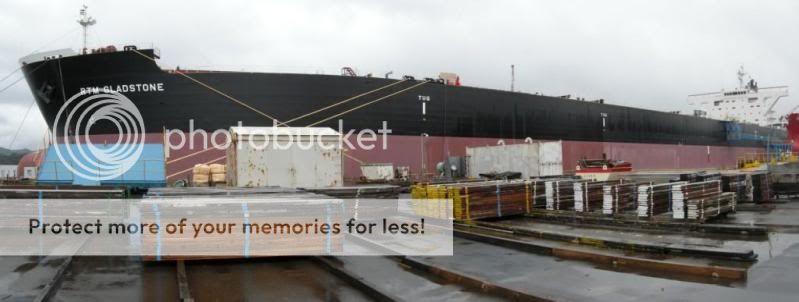
With typical Japanese efficiency, her construction continues toward the dock divider where there is a 250,000 DWT ore carrier. When her hull reaches the divider, the ore carrier has to be floated out and the divider repositioned. Like her sister Dias, she will float out stern first to the Fitting Out Quay.

Up against the Dock Divider, No.5 Hold enclosed
'RTM Dias put to sea in mid-December for sea trials and delivery into service in January. Many thanks again to Dr Paul and Asanomi-san for the photos from Imari.

AM

Tuesday, 16 October 2012

Launching 'RTM Dias'

On Saturday 13th October, Hull S.364 - to be named 'RTM Dias' - floated out of her building dock in Imari, Japan. RTM Dias is the 6th Post-Panamax to be built for the AM's Company but is to a different design to RTM Wakmatha. At 38 metres beam and a full double-hull design, she will be suitable for coal and bauxite cargoes and will enter service in early 2013.

The photo montage tells the story. My thanks to Paul and Asanomi-san from the KML Site Team for these photos and for climbing up on the Yard's gantry crane for the magnificent overheads.


In the Building Dock before flooding.
Flooding the dock 
Energy saving devices - Namura Fin and Rudder Fin


The Antipodean Mariner

Friday, 28 September 2012

Post-Panamax progress

Since the last post of RTM Dias (Ship 364) on 19th September, progress has been rapid. This sequence covers 5 days (23rd to 27th September) when the ship has gone from No.3 Hold to the complete hull in the building dock.

No.3 Hold
Starboard side of No.2 Hold and transverse stool
being lifted in to place
No.2 and No.3 Hold tank-tops and ballast tanks
Bulbous bow attached
Accommodation block lifting on
Add caption
 Thanks to the KML Site Team and Asanome-san for the sequence.

The Antipodean Mariner

Wednesday, 19 September 2012

The second Post-Panamax series

Ticking along quietly in the background has been the construction of two Post-Panamax bulk carriers, Ships 364 and 365, in Imari Japan. This pair will go to work in the bauxite and coal trades next year, but differ significantly from the five Post-Panamax already in service.

These designs are a variation on a standard coal carrier and are innovative for their full double hull construction. Most bulk carriers have a section of single hull between the lower hopper and topside ballast tanks. These vessels' holds have smooth sides, with all structural strength contained in the wing ballast tanks, similar to a modern double-hull oil tanker.

The operational benefits of double hull are that the cargo doesn't 'hang up' in the side structure, the vessel can carry all her water ballast in wing tanks and doesn't require a Ballast Hold.

The current schedule will see S.364 (RTM Dias) go to sea trials in November, for delivery in January and her sister-ship (RTM Flinders) in March. The Antipodean Mariner has stitched together a quick montage of progress since August, finishing with the loading of the Main Engine today (a Mitsubishi 6UEC60LS II-ECO slow-speed, 2-stroke diesel).


S.364 Engine Room and No.5 Hold Double Bottom

No.5 Hold lower stool/bulkhead and start of Hold 4


No.5 Hold enclosed, No.4 Hold starboard side lifting in to place
MHI 6UEC engine being lower into place

Thanks to Dr Paul R. and the KML Site Team for these photos.

The Antipodean Mariner


Thursday, 10 May 2012

Shinto Safety Prayer Ceremony for S.364

One of the fine traditions at the Shipyard where Ship 364 is being built is the Shinto blessing of the first hull blocks for a safe construction. The blessing is performed by a local Priest and attended by the Site Supervisors, Class Surveyor and Yard Personnel.

Another ceremony, involving a barrel of sake - origins unknown - is performed at delivery.

AM

Blessing of the hull block

Prayers are offered

To a safe build and successful keel laying


Wednesday, 2 May 2012

Cutting steel

From tiny acorns, mighty oak trees grow - 14th Century English proverb

An auspicious day in April with steel cutting of the next series of vessels, two 88,000 DWT bulk carriers. The vessels are Post-Panamax (38 metre beam) shallow draft for bauxite and coal. The first hull S364 will be delivered in December this year and her sister ship S365about three months later in 2013.

The first keel block will be laid in the Dock in August, the hull floated out with accommodation and main engine fitted in October, sea trials in December. This series are fully double-hulled, for ease of cleaning between cargoes, and carry their full ballast capacity in the double hull. No ballast hold!

The Antipodean Mariner


General Arrangement of the 88,000 DWT Post-Panamax Bulk Carrier
First plate on the plasma cutter

First steel plates cut for the Post-Panamax on the shop floor
The Engine Room double bottom block, which will fulfill
the Keel Laying in August

Saturday, 24 October 2009

Post-Panamax Ore Carriers: special-purpose bauxite ore vessels

My Company has just taken delivery of the final vessel of a series of five Post-Panamax ore carriers, built at Namura Imari Shipyard. This post describes their construction from concept to delivery.

My Company operate two alumina refineries, and have an annual demand for about 14 million tonnes of bauxite to be delivered for processing. Bauxite is also exported and sold in the international commodity markets, predominantly China.

The initial feasibility study called for a shallow draft bulk carrier which could be discharged at a Panamax berth within the typical gantry outreach. Post-Panamax coal carriers were identified as meeting the dimensions for the load and discharge ports, but were too wide to reach the outboard side using Panamax-outreach gantries. Working with Namura's initial design team, the high-cubic capacity coal carrier hull cross-section was modified for the heavy bauxite ore. The resulting design provided self-trimming holds which brought the ore within reach of Panamax-outreach gantries in an Capesize bulk carrier beam.


The vessel are operating within a sensitive marine environment, and load about 83,000 metric tonnes on 12.2 metres draft - about 40% more than a standard Panamax bulk carrier.

The contact was placed for the five ships, and the first vessel was delivered in 2007, with deliveries spaced about every 6 months until 2009.


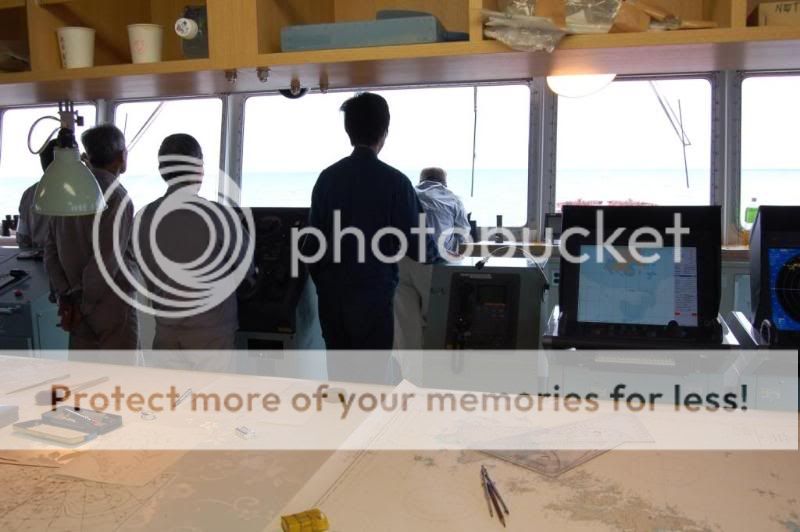
I attended the sea trials of the second ship as Owners Representative, off the south-west coast of Japan in late summer 2008. The third ship was under construction in block assembly as we prepared for the trials.


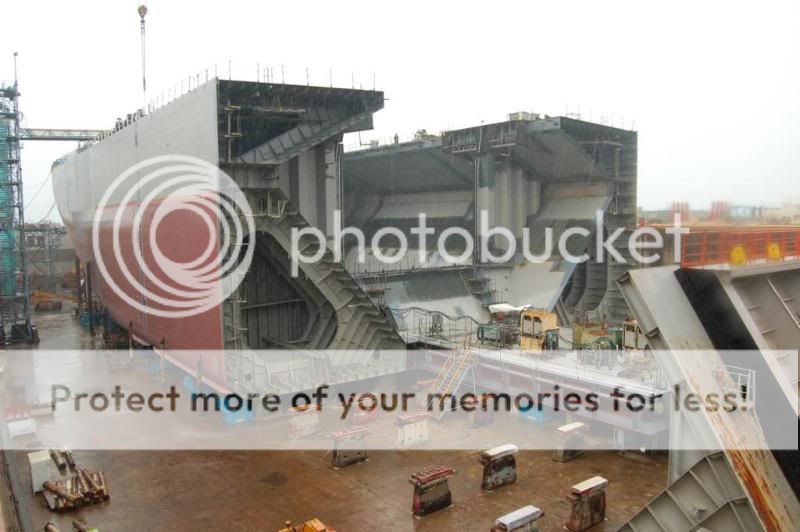
This photo of the No.4 Hold shows the shedder plates which self-trim the ore into the small tank-top.


The Japanese Yard crew took her off the berth - we joined her at anchor to witness the Deadweight Calculation - and then sailed that afternoon for the open water for speed trials. While we were anchored, the ship's freefall lifeboat was launched as part of the barrage of acceptance tests.


Trials took two days, and the ship was accepted as attaining her guaranteed contract speed at the post-trial meeting as we berthed back at the Yard.


2009, and the final ship has just been delivered into service. The Owners Supervision Team has gone their separate ways after four years and five successfully deliveries. The next project is three 250,000 DWT Ore Carriers, commencing construction in 2011.


The Antipodean Mariner
24th October 2009