Showing posts with label Rena. Show all posts

Tuesday, 1 November 2016

120 Days at Astrolabe

For long-term Followers of this Blog, the heady days of the Rena salvage in 2011 was the making of the 'Antipodean Mariner' as the unvarnished story from Astrolabe Reef, penned by Captain Kevin Judkins as Master of the AHTS 'Go Canopus', was fed to the Web as a daily serial.

With the blessing of Daina Shipping (Rena's Owners), Captain Kevin Judkins has published a book of his personal story and photographic record during the salvage operation.


The book '120 Days at Astrolabe' contains Kevin's personal diary and hundreds of unpublished photographs taken by him and others at the wreck site.

It's a fabulous record of the operation, from the perspective of a professional mariner experiencing a once in a lifetime event up close and very personal.

The book is self-published and can be purchased direct by contacting the author at rena120daysatastrolabe@yahoo.com 

Drop Kevin an email and get your copy mailed to you from New Zealand.

Stuart Scott
The Antipodean Mariner
November 2016


Thursday, 6 December 2012

Rena, salvage and contractual fairness

When the Salvors of the 'Rena' needed a small tanker to receive the bunkers, lubes and hydraulic oil, their first call was to SeaFuels for their bunkering tanker 'Awanuia'. SeaFuels shuffled around their bunkering programme at some cost and inconvenience and chartered her to Svitzer for an initial seven day period for a tidy sum (reported to be north of $NZ180,000 a day).


Awanuia de-bunkering Rena: Maritime NZ
Svitzer then rolled that short term charter over twelve times on the same terms and conditions.

Svitzer are now claiming that the contract (the one voluntary renewed twelve time) as unconscionable and they they should be able to get the Court to set a more reasonable hire rate retrospectively.

As the legal points relate to application of the salvage convention and the provision to give priority to the protection of the environment, this case is attracting attention from maritime Lawyers. This article is from Lloyd's List and examines the legal issues surrounding whether the Convention can be cascaded down to sub-contractors providing supporting services.

A fairly dry legal read, but with all the elements of a best seller.

AM

Can salvage sub-contracts be set aside for unfairness?

Landmark litigation is under way in New Zealand in relation to the Rena salvage

Simon Tatham and Mike Allen, Lloyd's List - Thursday 6 December 2012

IT IS rare in practice that provisions of the 1989 International Salvage Convention fall under the judicial spotlight.

Many are familiar with the famous provisions of Article 13 in assessing salvage awards and others are only too happy to forget the infamous Article 14 killed off, in effect, by the incorporation of Scopic within Lloyd’s Open Form.

Less so Article 7, however, which is currently the subject of litigation in New Zealand in the context of the Rena grounding. In that case the salvage, now a separate wreck removal operation, was initially commenced under LOF terms with Scopic invoked. The most suitable tanker available to receive the casualty’s bunkers was chartered in at short notice by the salvors, Svitzer. It all happened very quickly, as bad weather was expected.

The parties entered into a short-term sub-contract on the Supplytime 2005 form with rates and other terms following for discussion only after the tanker was already under way for the grounding site. Unfortunately for the salvors, many weeks later the price, originally sought for an expected seven-day job, was now running into millions of New Zealand dollars.

No doubt coming under pressure from the P&I Club that was picking up the bill under Scopic together with the usual uplift on expenses, the salvors eventually applied to court seeking an order that the contract be annulled or the price modified pursuant to Article 7. The interesting question, among others in dispute, is whether this provision applies to a sub-contract as opposed to the salvage contract itself.

To turn the clock back, reflecting to an extent old case law on the jurisdiction of the Admiralty Court, the preceding Brussels (Salvage) Convention of 1910 contained a provision that every agreement as to assistance or salvage entered into at the moment and under the influence of danger may, at the request of either party, be annulled or modified by the court, if it considers that the conditions agreed upon are not equitable. It is reasonably clear from this that the convention was intended to apply to salvage contracts only.

However, the provision was subtly changed in the 1989 convention. Article 6 provides that the convention applies, in rather broad terms, to “salvage operations”. Article 7 then provides that “A contract or any terms thereof…” may be annulled or modified by the court if its various tests are met.

In other words, the convention draughtsmen did not specifically restrict the scope of this narrowly to salvage contracts.

Reading these two articles together, does a contract entered into for the purposes of or in the context of a salvage operation fall within the ambit of the convention so as to give a court the power to modify or annul?

If so, then potentially every contract for services entered into between a salvor and a sub-contracting third-party supplier may likewise be caught. Of course, the applicant is still required to show that the contract was entered into under undue influence or influence of danger and the terms are inequitable terms, or that the payment is in an excessive degree too large or too small for the services actually rendered. These are fact dependent and quite high threshold tests.

Nonetheless, this is or should be a concern for the salvage industry and in particular their sub-contractors. Salvors frequently have no choice but to pay exceptional rates to local contractors either because time does not permit haggling or the contractor is the sole provider of essential craft or equipment or simply because the action is taking place in a difficult corner of the world.
Is it desirable that salvage contractors might agree to those terms in the knowledge that the agreement can be revisited in due course? Of course it might cut both ways inasmuch as that same threat might temper the financial ambitions of the less scrupulous suppliers just as it might assist P&I clubs in keeping a lid on runaway Scopic expenditure where not all salvors, conscious of their 25% mark-up on expenses, might go that extra mile to negotiate the best prices.

A final point lest this is not entirely clear. The convention will be applied by the tribunal chosen under the sub-contract, not the LOF arbitrator.

Returning to the litigation in New Zealand, the sub-contractor tanker owners applied to strike out the claim on grounds that the convention was never intended to apply to third party sub-contracts. The judge at first instance decided that there was a triable issue, and so the case goes on.

As it is unlikely that a similar case will crop up, and this is the first on the point since the 1989 convention came into force, the salvage and P&I world is, or should be, looking closely at the outcome.

Simon Tatham is a solicitor and partner of Tatham Macinnes LLP and Mike Allen is a consultant with TugAdvise, a specialist legal service advising those concerned in the tug and OSV markets.

Saturday, 16 June 2012

Demobilisation

With 'GO Canopus' off-charter from the salvage of Rena, Captain K penned the following final message before departing Tauranga for de-mobilisation of the boat in Bali. Like a gift that keeps on giving, my heartfelt thanks to Captain K, Captain MP and everyone who has contributed to the Antipodean Mariner blog over the last 9 months.

I was up at 03:30 this morning, after having quite a good sleep. The walk around the mountain last night had had the desired effect. The mates were due to change from 12 hour watches to traditional 4 on 8 off sea watches this morning.
There was a stiff Westerly blowing all morning, gusting to 40 knots at times. At least it was blowing us directly on to the berth, so there was no danger of mooring lines breaking or the ship ranging along the wharf at all. Hopefully it would ease prior to sailing. I don’t fancy going out in the dark while it is blowing forty knots.
Other than for a couple of phone calls about loading enough fuel for the ship to get to Bali, I have not received any formal notification that the project is over and our charter terminated. Most odd.  On Saturday I had ordered some additional charts to get us through Torres strait and to Bali. They are due at noon today, which is cutting it a bit fine. We can’t sail without them.
I have opted to go through the northern passage of Torres strait, which is but an 18 hour transit, rather than the 5 day inner reef passage. The pilot book indicated that the south east trades were the predominant wind pattern through the Coral sea at this time of year, so this route would give us following weather once clear of the northern Tasman sea.
The weather map was not looking good further north. A deep low has formed off the Queensland coast, which will impact us in a couple of days time. All going well, the weather should be on the starboard quarter, which although uncomfortable, should not adversely affect our speed.. In fact, once on the northern side of it, we should benefit from following seas.
It was still dark when the first fuel trucks rolled on to the wharf soon after 06:00. They were very well organised and commenced bunkering us at 06:15.
About the same time, a minivan showed up at the gangway of the Smit Borneo, obviously ordered to take demobilized personnel to the airport. Like any other project, once notice of termination has been given, personnel are demobed very quickly, as there is no economic sense in paying people when they are not needed.
By mid morning, I had confirmed the sailing time for 20:00 hours tonight, to allow time to complete the loaded bunker survey and get things secure for sea. It would also give personnel (including myself) enough time to catch a nap, prior to sailing. Bad form if an incident occurred while departing the port and I had been up without a break since 03:30.
There were lots of little jobs to complete today, but nothing too difficult. We topped up our fresh water this morning, even though our tanks were almost full. No one knows when we will next have the opportunity to fill them.
The chief mate went up the road for some last minute shopping, so I had him post my entire memoirs to Captain MP in Wellington, just as an insurance policy, should something befall me or my hard drives, between now and  when I am due to return home.
 Once the office opened in Perth, I phoned the ops manager and asked him to send me some official notification of termination of charter. He promised to do that, along with issuing voyage orders for Bali. It never hurts to get these things in writing.
The food and dry stores arrived at 13:00 as scheduled and were quickly loaded aboard.
I went with the Agent to rent some DVD’s for the voyage and buy some heavy duty fishing gear. I bought some heavy long line monofilament with a breaking strain of probably in excess of 400 kgs, swivels and large double hooks,– nothing sporting here.
Reminiscent of my days with Dilmun tankers. When travelling at 11 knots, one needs heavy gear to absorb the strike impact of a 40 kg Wahu, Mahi-mahi or Yellow fin Tuna. We can’t slow down or stop to play it or reel it in sportingly.  The crew were quite astounded at the size of the gear I bought, even the experience fisherman 2nd mate. I recall on the delivery voyage of the Searanger, we pulled in several Mahi-mahi jaws, without the rest of the fish, such is the force of water rushing into a fishes open mouth. Not very nice to think about.
The customs clearance officer arrived at 14:15 and granted us outward clearance 20 minutes later. The advantage of having all of the paperwork prepared in order for him.
All throughout this time, the fuel trucks kept rolling in and out of the wharf, delivering us the planned 550 cubic metres (550,000 litres) of gas oil. The discharge to us was completed soon after 1600. I went on the wharf and took a few photos of us refueling, along with shots of the Smit Borneo demobing her gear. There was nothing special about the photos though, nowhere as impressive or dramatic as many of those I have shot out at Astrolabe reef in the preceding 8 months.
I turned in soon after that, as planned. Didn’t sleep at all, but a two hour lie down is certainly better than nothing.
When I arose, things were well in hand for sailing. The wind was still a brisk WSW’ly, but had eased under thirty knots during the afternoon. An hour before sailing then technician returned our repaired Converteam DP computer screen. I had been chasing it up for a few days, as I needed the external frame from it, should GO decide to replace the wide screen with an original size one. Nothing like leaving it to the last minute is there.
We departed the wharf at 20:01, using a lot more horse power than I have had to use in the past, due to the strong wind. The departure went without a hitch and we were clear of the port half an hour later, passed “A” beacon, heading due North. I thanked the port radio operator for all of their assistance over the months and asked him to pass on my thanks to the pilots and the rest of marine team. It was sad to say my final farewells to Tauranga.
In spite of the obvious tragedy of the grounding, pollution and sinking, this project has afforded me an incredible experience and a once in a life time opportunity. The emotional journey, memories, friendships and photographs will last me a life time. That I had the foresight to record my observations from day one and the courage to continue doing so throughout, is something that I am eternally thankful for.
Hopefully the select few, who I have trusted to share these with, along with my sometimes most intimate thoughts, will feel the same way.
Details fade from the memory with the passage of time, whereas my written word and photographs will remain as an accurate account of events as they occurred. One day perhaps, when the Orwellian nature of the agreement between MNZ and Svitzer has been exposed for the Stalinesque abomination that it is, they will be in the public domain.
Until then though, they remain the Rena blogger's secret diaries.
Signing off from the Bay of Plenty for the very last time.
Captain K.


AM

Tuesday, 12 June 2012

Rena salvage demobilisation

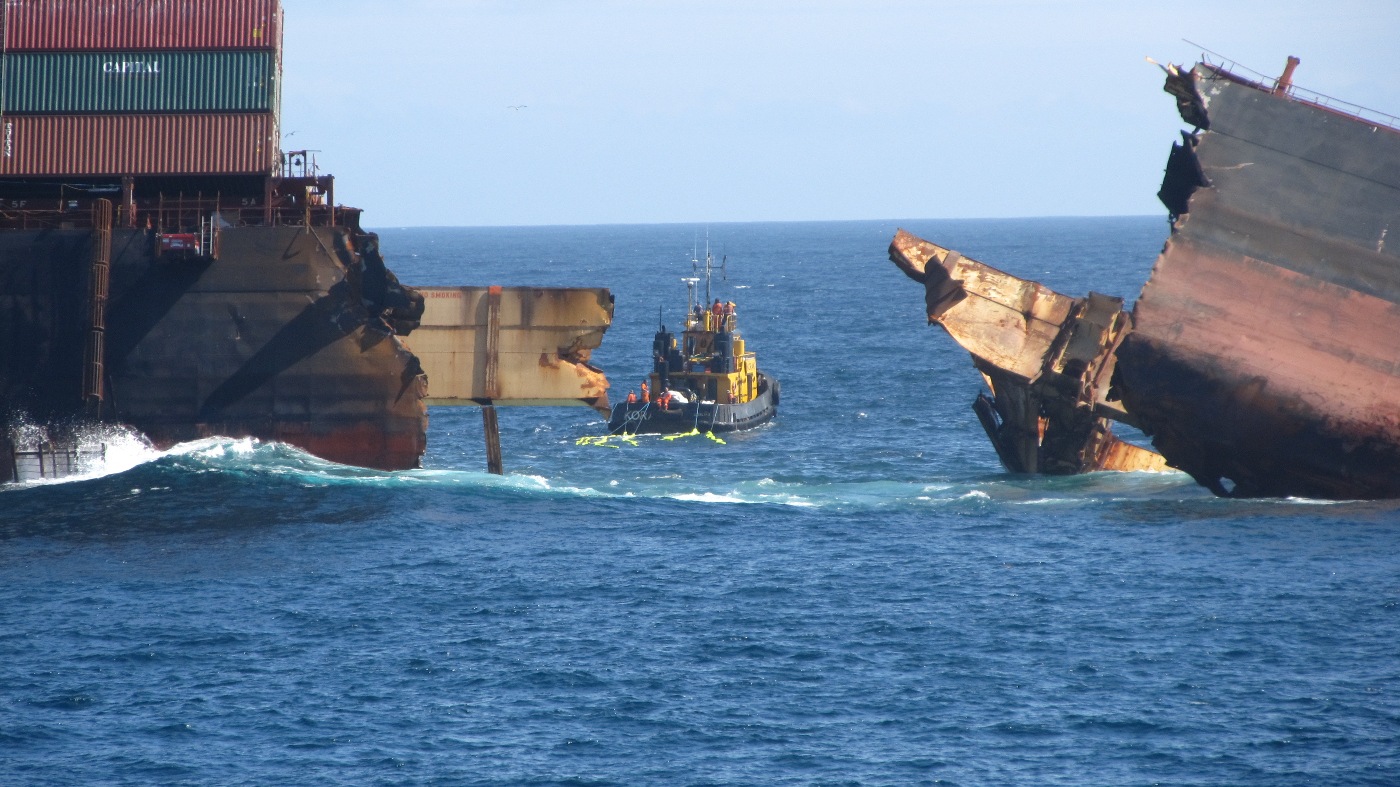
The Antipodean Mariner's man at Astrolabe Reef reports that they have received orders to demobilise from the site.  The last of the containers have been removed from the forward section, Smit Borneo is under tow by Smit Singapore and Rena is (temporarily) left to the forces of nature while the wreck removal is being put to tender.

No more boxes

Longitudinal girders gone

With the salvage ended this is probably the last post until the TAIC report is released. It's been an interesting ride, with big thanks to a my mates who 'flipped the bird' to MNZ's media relations team and the draconian 'non disclosure'. Everyone's a reporter now...


The closing post wouldn't be complete without a plug for 'Black Tide' by John Julian. The book explores the 'what could have been' with expert opinion from salvors and mariners who incidentally weren't part of the good news spin cycle. A good read with no agenda and plenty of informed dialogue.

Antipodean Mariner

Thursday, 31 May 2012

Where's the Monaro?

AM was pessimistic about whether Troy's Monaro would be salvaged - the exchange below has been quietly continuing in the 'Comments' section of the 'Astrolabe Reef Towies' post.


Holden Monaro HQ - an Aussie classic
Thanks for the update AM. Theres still a slim chance for the old monaro yet. Would you be able to find out any info on its fate, the loading position is Bay 9 Slot 03 Tier 04. thanks Troy Levien on Astrolabe Reef Towies


Not great news I'm afraid, Troy.I had a look at some of the close-up photos and Bay 9 is aft of the hull break. She folded at Bay 6, so Bay 9 is about 20 metres underwater with the after end. AM on Astrolabe Reef Towies


Oh that doesn't sound good, I am not in the shipping business but is a "hold" different from a "bay"? I looked at a container loading diagram and the numbering sequence for 20 ft containers is bay 1,3,5,7,9 etc. and 40 ft containers is bays 2,4,6,8 etc . Which are in turn divided into the holds of the ship. So my theory was that my container is in hold number 3 under the row in which that Mercedes came from..... on Astrolabe Reef Towies


Here's the shot of the airborne Merc with Rena in the background. Troy, you are spot on with the 20 foot cell numbering convention. Your Monaro should be in Bay 9 at the aft end of Hatch 3, Slot 03 is two slots to starboard (even Port, odd Starboard) of the centreline and Tier 04 is second height (tier 02, hold bottom, tier 04 second height). Assuming 2 metres of mangled double bottom structure and 2.5 metres for the 1st tier container, your Monaro should be about 4.5 metres above Astrolabe Reef.

Keep us posted...

AM

Saturday, 26 May 2012

O TAIC, where art thou?

As Captain Balomaga and Second Officer Relon begin their final incarceration the Antipodean Mariner asks why can't the Transport Accident Investigation Commission (TAIC) produce an investigation report eight months after the grounding?

This is not rocket science. No-one died, the ship's charts and records were recovered intact and the Crown Prosector has brought the case to a concluding trial and sentencing in this period. The Root Cause Analysis fundamentals of determining unsafe actions and unsafe conditions are pretty straight forward for a skilled investigative team.

The reason for the AM's "pissed off" attitude is that with the close of the criminal case against the Captain and Second Officer, the other players in this tragedy can slink off behind their respective corporate anonymity with some confidence that their roles will not garner too many headlines when the findings are issued.

The AM cannot dispute the facts of the grounding or condone the individual actions of the two mariners. However, mariners don't deliberately set out to have a grounding, spend months under detention separated from family and and then jailed. Mariners for the most part are the 'pointy end' of casualties and criminalisation because commercial imperatives make unsafe acts a viable solution.

While the TAIC report remains 'work in progress', the individual and collective contributions to the grounding the Rena will fade from the public's memory and Captain Balomaga and 2/O Relon will be immortalised as the only villains to be publicly punished for their actions on the morning of October 5th 2011.

The Antipodean Mariner

Saturday, 5 May 2012

Ingots

Rena continues to give up little treasures - this week it was aluminium ingots. New Zealand Aluminium Smelters at Tiwai Pt, Bluff imports alumina and exports ingots and bar. Some the highest purity NZAS aluminium is used in the wing structure of the Airbus 380. This cargo was loaded in Bluff at the start of Rena's northbound voyage on September.


Packs of aluminium ingots were flown off the Rena, apparently 'none the worse for wear', over the past few day and will join the valuable salved property in the bonded Yard in Tauranga. The current price of aluminium is about US$1,900 per tonne so there will be some positive financial contribution.


The Antipodean Mariner


Aluminium ingot pack on its way


And stowed ready for off-loading


Tuesday, 1 May 2012

Astrolabe Reef Towies

Activity at Astrolabe Reef has, in the words of one contributor, become Groundhog Day. The salvage has moved to a daily routine of debris removal as the Salvors ponder what to do with the sunken after section of Rena.

Every person at Astrolabe Reef has been reminded again of the blanket non-disclosure of text, commentary, opinion, photos or video footage of the salvage operation. Funny to think that this is New Zealand and not Stalinist Russia.

The world's most expensive two truck
Someone got lucky yesterday when a Mercedes Benz E200 was recovered (un-immersed) from the forward holds and flown off by the McDermott helicopter. It may have already been paid out as a total loss but appears to have a few boxes of personal possessions in the back seat. No sign of any Monaros at this point, Troy.


Merc slung under the McDermott chopper for the short ride home
The Antipodean Mariner

Wednesday, 4 April 2012

Seagate/Timor Stream and Rena

Followers love a good maritime disaster - the page hits don't lie. This tale of woe comes from the Caribbean, where the UK registered 'Seagate' collided with the 'Timor Stream. Amazingly, no fatalities though one crewman was pickd up from the sea by a passing yacht.

The bow of the Timor Stream has penetrated right in to the engineroom of Seagate,taking what would likely be the Officers Mess and Ship's Office on the starboard A Deck.


Seagate


Depth of penetration into the accommodation


Part of Seagate's lifeboat davit draped over the bow


Remarkably little damage to Timor Stream

And news closer to home, Rena's stern section has 'fallen off' Astrolabe Reef today, leaving only the bow visible. More photos of Rena at Maritime NZ's gallery.


AM

Thursday, 8 March 2012

Release of the interim Rena report

TAIC's interim report on the grounding of Rena has been released today and has been widely reported in the New Zealand media. This posting is for the wider readership and there are several stories with comment and analysis on the wire services.

Despite being an interim, the report appears to identify most of the contributing factors. The vessel lost time on her schedule in Napier, due to another vessel having a priority for the berth and stevedores. When she sailed from Napier, reporting an ETA Tauranga of 0230 on the 5th, the Master shortened the course around the Mahia Peninsular to make up time.

At midnight on October 5th, Port Control told the Second Mate that the ship's ETA of 0300 at the Pilot Station was right at the end of the tidal window for entry. Between 0100 and 0200, the course was progressively altered to port in small increments.

Although it appears Astrolabe Reef intermittently showed up on the radar, the absence of an 0200 position plot on the chart meant the bridge team didn't appreciate what the 'paint' was. At 0214, as the Master was making his way to the chart room to plot the ship's position, Rena grounded at 17 knots.


Chart of the Bay of Plenty and the vessel's track from TAIC's Interim Report

While the Master and Second Officer are squarely in the gun, the Antipodean Mariner continues to hope that TAIC's full report will look at the overt commercial pressures put on Masters to meet schedules published weeks earlier by Owners and Charterers. One thing for certain is that the Master and Second Officer will probably spend a lifetime asking themselves on how they ended up on Astrolabe Reef.

AM

Tuesday, 6 March 2012

Astrolabe Reef update

Astrolabe Reef has been relatively quiet this weekend with the absence of Smit Borneo. Scheduled maintenance has apparently turned out to be major repairs to the barge's roller fairleads, which lead the anchor wires out to the mooring spread.

With an ETA at Astrolabe Reef not expected before the coming weekend, the Salvors have been cutting up containers in situ and then heli-salvaging the remnants to the barge Pohonui for haulage back to Tauranga.


The McDermott helicopter transferring what remains of an MSC 40 foot container to Pohonui


The AM is guessing that the Salvors are getting down to the dregs now and wonders what the decision-making process is to assess the 'cost to benefit' equation of flying off small pieces of scrap metal from a big piece of scrap metal?

AM


Sunday, 4 March 2012

Storm passes

The bad weather lashing New Zealand's north has passed over Astrolabe Reef and Rena has been remained unmoved. In comparison to the January storm which brought in heavy swells from the north, this storm came from the west with less fetch for sea and swell to build. No walk in the park though for the standby vessels monitoring the wreck site while 'Smit Borneo' was alongside in Tauranga for repairs and maintenance.

With the decks clear of containers, the Salvors are reported to be cutting into the boxes below decks to unload their contents in situ.


Rena being lashed by Westerly gales at Astrolabe Reef

The Antipodean Mariner

Friday, 2 March 2012

Storm at Astrolabe Reef

New Zealand is battening down for a storm this weekend, but out at Astrolabe Reef the faithful are maintaining their vigil over the Rena.


Winds are forecast at 40 knots, gusting to 60 knots, and Smit Borneo has been berthed in Tauranga to avoid the worst of the weather.


The calm before the storm - Smit Borneo and Go Canopus (LOC/Maritime NZ)

The condition of the two parts are being monitored as the heavy swells could cause the stern to drop into deeper water - the bow seem to be well grounded and has apparently not moved since October.


Photo: Vaughan Williams, Maritime News Clippings

Any change in status will be posted but this weather system is the worst forecast since Rena sank on 10th January.

AM

Wednesday, 29 February 2012

Rena's Master and 2/O plead guilty

The Captain of the cargo ship which grounded on a reef off Tauranga last year has pleaded guilty to all charges against him.

The Rena hit the Astrolabe Reef in October last year causing an environmental disaster - spilling oil and containers into the water and killing masses of sea animals. The stricken ship broke in two early this year.

The captain pleaded guilty today in the Tauranga District Court to charges laid under the Maritime Transport Act, Crimes Act and Resource Management Act.

The ship's navigation officer, whose name is also suppressed, also appeared in court today and he pleaded guilty to a charge laid under the Maritime Transport Act and three Crimes Act charges.

Both men face the same charges; under the Maritime Transport Act 1994 for operating a vessel in a manner likely to cause danger, under the Resource Management Act 1991 for discharging a contaminant and on three charges under the Crimes Act for altering ship documents.

The captain faces one additional charge under the Crimes Act for altering ship documents.

The charges under the Crimes Act each carry a maximum penalty of seven years imprisonment.

The RMA charge is under section 338 (1B) and (15B) relates to the 'discharge of harmful substances from ships or offshore installations'.

It carries a maximum penalty of a fine of $300,000, or two years imprisonment and $10,000 for every day the offending continues.

The Maritime Transport Act carries a maximum penalty of $10,000 or a maximum term of imprisonment of 12 months.

Sentencing for both men is scheduled for May 25 at the Tauranga District Court.

The navigation officer is scheduled to reappear in the Tauranga District Court on May 22 where more pleas are expected.

Source: http://www.stuff.co.nz/environment/rena-crisis/6498529/Rena-captain-pleads-guilty-to-all-charges

Sunday, 19 February 2012

Recovery

The title of this post is recovery, as opposed to salvage. Work at Astrolabe Reef is the grinding and unglamorous task of recovering waterlogged containers and their contents which for the most part have been submerged in sea water for almost five months.


A twenty foot shipping container when loaded has a tare weight of about 2.5 tonnes and cargo weight of 25 tonnes give or take. The combined effects of being waterlogged and damage to their structural strength has resulted in many of the boxes simply folding when they are pulled out of the Rena's holds by Smit Borneo.


The sequence below is the contents of a container carrying Mitavite Breeda as it is drawn out of the submerged cargo hold.


The Salvors were reduced to slitting open the bags of the waterlogged and decomposing horse feed, recovering the plastic wrappers and giving the fish a free lunch.

That's all the news today from Astrolabe Reef.

The Antipodean Mariner

Wednesday, 15 February 2012

Squaring Away

Squaring away is an old sailing ship term to describe the crew's final task at the end of the voyage, squaring up the yard arms on the masts and making ready to pay off. Squaring away in the context of the Rena will be the final reckoning of costs.

A recent report in the NZ media put the Rena's salvage bill at $130 million, of which about $28 million was on the Government's tab. With the sole tangible assets of the salvage to date being the container discharged off the deck - many of these empties owned or leased by MSC - the Antipodean Mariner wonders when the Insurers will say enough is enough!

Let's recap the layers of insurance and who has their hand out, by way of insurable interest.

The ship was beneficially owned by Costamare, and now that she is resting on Astrolabe Reef in two parts it is incontrovertable that she has become a Constructive Total Loss. It is therefore probable that Costamare have been paid the insured value under the Hull and Machinery Policy. As nothing was salved from the hull, the Insurers have nothing of value and effectively own the hulk along with the responsibility for wreck removal if this is successfully enforced (under the Resource Management Act?)

MSC lost equipment, in the empty and full containers both lost overboard and salvaged and now held as security by the Salvors at several container parks in Tauranga. They also 'lost' the bunkers that they, as Time Charters, had provided to the Rena. These will form the basis of a claim by MSC on their own insurance, and if the bunkers, lubricants and hydraulic oils can be re-refined there may be a small financial clawback for MSC's insurers.

The Protection and Indemnity insurance cover for oil recovery, pollution prevention has a way to run at over $1 billion, but the Swedish Club is obliged to act reasonably and in the best interests of the self-insuring Members who are paying the bills.

What the AM questions is the effort being expended salvaging water-damaged bags of milk powder off the bow section of Rena, and flying it ashore by helicopter to its inevitable end in a landfill. If the cost of recovery exceeds the (nil) salved value, who is paying for the fleet of maritime and aviation assets to engaged in the ever diminishing exercise?

The point must be fast approaching when the Insurers tell the Salvors and NZ Government that they have satisfied their obligations and that Rena poses no risk that further salvage can mitigate. While the AM is sure that the well intentioned  agencies of Government will settle for nothing less than every trace of the ship and her cargo being removed from Astrolabe Reef, this is not practically achievable. The wreck poses no long term threat to Astrolabe Reef or navigation into the port of Tauranga, and is no doubt being populated by fish.

How the agencies of the NZ Government deal with 'expectations management', when the Smit Borneo is towed over the horizon, will make for an interesting space to watch.

The 'pot of gold' involved no digital alteration, just the photo-stitching of the fortuitous placement of Rena and the tug Singapore.

AM


Friday, 20 January 2012

Anchor handling

Smit Borneo, while a complex and sophisticated salvage asset, is a dumb barge and needs an attendant fleet of towage and anchor handling tugs to position her at Astrolabe Reef. The anchor spread enables the barge to winch herself to the work site and hold position in the prevailing sea and swell. Each anchor has a tail, enabling the anchor handling tug to dislodge and relay.

This sequence of GO Canopus deploying one of Smit Borneo's anchors and buoy.

AM


Wednesday, 18 January 2012

Digital confetti

The Antipodean Mariner has been following the general and specialist maritime media coverage of Costa Concordia. Black boxes, AIS, smartphones and even Facebook have been used to reconstruct the last hours of the vessel with incredible accuracy and insight into the minds of the main protagonists.

The digital confetti trail which follows ships, both formal and informal, is an indellible record immune to tampering but still highly transparent. The loss of Costa Concordia dwarfes that of the Rena but shows that with enough effort, information in the public domain can be reconstructed and disseminated ahead of any formal inquiry. AM believes that informed analysis will fill any information void left by officialdom, and hopes that TAIC will issue something substantive on Rena earlier than the promised mid-year statement.

AM


Sunday, 15 January 2012

Last word from Astrolabe Reef

The AM's travelling for a week and using the Android Blogger app on the Samsung Galaxy tablet. In what may be the final communique from Astrolabe Reef, a close friend of the Antipodean Mariner eloquently described his feelings as they put their stern to the Rena for the last time;

The Rena is just a hulk now, whose carcase will be picked over by salvors, divers, insurers, politicians and lawyers for years to come. She no longer has any grace, life, mystique or majesty - the love affair is over.

The AM will keep a weather eye on Astrolabe Reef but the prize of salvaging the Rena has been lost.

AM


Friday, 13 January 2012

Astrolabe Reef and 'no go' zones

A quiet day yesterday at Astrolabe Reef with GO Canopus 'standing by' and Koraki towing around an oil absorbent boom. New Zealand is copping another low pressure system with a gale warning for sea area Plenty.

Koraki and GO Canopus on opposite sides of Rena


Friday's isobar chart


A maritime expert has opined that New Zealand should introduce compulsory 'no go' zones to stop ship's taking short-cuts around the coast but the AM's smells a bit of self-promotion of a commercial product. Every ship's Safety Management System contains instructions to the Master and Navigating Officer on passage planning. While ships have schedules to maintain, 'no go' zones will be just another useless layer of unenforceable regulation.

AM